Du er her: hjem | Reynolds 33 | Sikkerhet | Kullseiling
R33 Turbo capsizes 5 miles offshore California Coast!!!
Av Randy Reynolds
Sounds pretty scary doesn't it ??? Imagine a 33 foot long 18 foot wide 54
foot tall rigged catamaran capsizing at 17 knots of speed in 3 foot seas, 4
foot swells and winds gusting to 18 knots. One would think that in the event
of such a capsize the boat would sustain substantial damage and warrant a
prolonged effort to "save the boat". How would you save the boat? Cut the
rig away, tow the boat into the harbor and use a crane to right her?
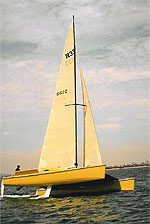 Many designers have theories on how to "right" a coastal racing/cruising
catamaran after a capsize. We have our theories and had planned to put the
R33 through a capsizing test. In designing the R33 cat many precautions were
taken to make the boat safe and strong in such an event. Just as monohulls
can sink, multihulls can capsize. I have always been of the opinion I would
rather be on a capsized multihull than a sinking monohull...treading water
sounds more stressful than sitting on top a stable platform. But never in my
wildest dreams did I imagine that in the event of a capsize it would be
possible for such a catamaran to protect her crew and, with a little outside
assistance, be back on her feet and sailing again in less than an hour! All
this with no damage to her hulls, rig, sails, crew or any other gear except
for maybe the bruised ego of her helmsman. Well, that is what happened last
Sunday, August 10th, 2003 as we put the R33 Turbo to the ultimate test in an
unrehearsed capsize 5 miles off the Southern California coast.
Many designers have theories on how to "right" a coastal racing/cruising
catamaran after a capsize. We have our theories and had planned to put the
R33 through a capsizing test. In designing the R33 cat many precautions were
taken to make the boat safe and strong in such an event. Just as monohulls
can sink, multihulls can capsize. I have always been of the opinion I would
rather be on a capsized multihull than a sinking monohull...treading water
sounds more stressful than sitting on top a stable platform. But never in my
wildest dreams did I imagine that in the event of a capsize it would be
possible for such a catamaran to protect her crew and, with a little outside
assistance, be back on her feet and sailing again in less than an hour! All
this with no damage to her hulls, rig, sails, crew or any other gear except
for maybe the bruised ego of her helmsman. Well, that is what happened last
Sunday, August 10th, 2003 as we put the R33 Turbo to the ultimate test in an
unrehearsed capsize 5 miles off the Southern California coast.
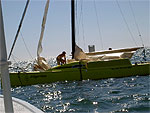 We were sailing along doing 17 to 19 knots on a beam reach with full main
and full jib. Although the conditions were moderate and we could have been
sailing at 12 to 14 knots without hull flying we opted to sail fast and on
the edge. This is what is great about the R33 Cat. For sailors who like the
lightweight feel of a small day sailing cat the, R33 has that feel. You can
sail her hull flying with more confidence due to her weight and size. In
fact, hull flying is safer than a small cat, because your reaction time can
be slower. The boat is so versatile due to her size, accommodations,
comfortable nine foot long cockpits and her easy reefing system, that the
R33 can also go into cruising mode by reefing the sails for the conditions.
This allows her crew to sail fast but without hull flying. Even with the
Turbo we have "cruised" the boat in 20 to 28 knots of wind with triple reef
main and full jib allowing us to hit speeds of 14 to 15 knots without flying
a hull and in total comfort. This versatility allows the R33 to be sailed as
wild or tame as her skipper and crew want her to be.
We were sailing along doing 17 to 19 knots on a beam reach with full main
and full jib. Although the conditions were moderate and we could have been
sailing at 12 to 14 knots without hull flying we opted to sail fast and on
the edge. This is what is great about the R33 Cat. For sailors who like the
lightweight feel of a small day sailing cat the, R33 has that feel. You can
sail her hull flying with more confidence due to her weight and size. In
fact, hull flying is safer than a small cat, because your reaction time can
be slower. The boat is so versatile due to her size, accommodations,
comfortable nine foot long cockpits and her easy reefing system, that the
R33 can also go into cruising mode by reefing the sails for the conditions.
This allows her crew to sail fast but without hull flying. Even with the
Turbo we have "cruised" the boat in 20 to 28 knots of wind with triple reef
main and full jib allowing us to hit speeds of 14 to 15 knots without flying
a hull and in total comfort. This versatility allows the R33 to be sailed as
wild or tame as her skipper and crew want her to be.
On this day her crew was comprised of performance sailors. Five crew were
onboard... Myself and the R33 Turbo's new owner Pau Gol from Spain (an "A"
Class Cat racer), his lovely wife Laura accompanied with their good friends
Acensi (better known as "the assassin" and expert sailor) and his lovely
fiancée also named Laura.
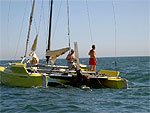 We had just finished two days of racing in Long Beach Harbor and were still
in the "go fast mode" as we had just beaten a very fast, very well sailed
F31 on elapsed time both days. We had been flying a hull most the day.
We had just finished two days of racing in Long Beach Harbor and were still
in the "go fast mode" as we had just beaten a very fast, very well sailed
F31 on elapsed time both days. We had been flying a hull most the day.
All of us were on the weather hull sitting very comfortably in our inclined
cockpit seats. Pau and Acensi were forward in the cockpit engaged in good
conversation. The girls were next to them engaged in their own conversation.
I was in the rear of the cockpit sailing fast with traveler in hand and
flying a hull off the wind for over 20 minutes when we were hit with an 18
knot gust.
Usually, this would be no problem. In a gust I would simply travel the main
traveler down and steer 10 to 15 degrees downwind; then sheet in and head up
again. But this time when the gust hit I traveled the main down only to have
it jam 8 inches down. This made steering the boat downwind too slow to
prevent a capsize. Releasing the main and jib sheets would have prevented
the capsize but because of the relaxed atmosphere on the boat the sheets
were not manned. Many lessons were to be learned in the next 60 minutes, one
of these lessons was that the mainsheet should have been on my lap as I was
the one sailing the boat. This may sound very obvious for a cat sailor.
However, with myself having almost 5000 miles of sailing the R33 in the last
year in more extreme conditions, I was too confident in my ability to react
in case of an emergency...such as a main traveler jamming. But, by the end
of this day I was going to learn, beyond my expectations, of the boats
seaworthiness, strength and safety for her crew at sea in a real life
situation.
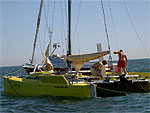 So with the main traveler jammed, the mainsheet tight, and the weather hull
flying higher and higher I knew we were going over. Our speed over the water
went from 17 knots down to 5 knots when the mast tip gently hit the water.
Three of the crew followed the slow roll of the boat by going over the top
of the cockpit seat and found themselves securely atop the hull. Another
advantage of the seatback seatback allows for a large 4 foot wide area to
sit on. Laura and I were caught on the other side of the seatback. We hung
onto the seatback until the water came to us. I let go first landing gently
in the mainsail only four feet away. I gestured to Laura to let go as well
and she also landed softly into the sail feet first. We were not wet yet as
we were standing on the mainsail in about 6 inches of water. But as the boat
kept gently rolling over Laura and I walked to the leach of the mainsail and
stepped off into the water so we would clear the boat as the boat slowly
rolled into a turtled position. We then swam 3 feet around the stern of the
boat and onto the trampoline. Pau, his wife Laura and Acensi were sitting on
the hull and then stepped onto the inverted tramp. They followed the boats
rolling action like a dinghy never getting wet except for walking through
the 4 inches of water a top the tramp after the boat turtled. Laura and I
were wet because of our 10 second swim but were now high and drying out on
the tramp.
So with the main traveler jammed, the mainsheet tight, and the weather hull
flying higher and higher I knew we were going over. Our speed over the water
went from 17 knots down to 5 knots when the mast tip gently hit the water.
Three of the crew followed the slow roll of the boat by going over the top
of the cockpit seat and found themselves securely atop the hull. Another
advantage of the seatback seatback allows for a large 4 foot wide area to
sit on. Laura and I were caught on the other side of the seatback. We hung
onto the seatback until the water came to us. I let go first landing gently
in the mainsail only four feet away. I gestured to Laura to let go as well
and she also landed softly into the sail feet first. We were not wet yet as
we were standing on the mainsail in about 6 inches of water. But as the boat
kept gently rolling over Laura and I walked to the leach of the mainsail and
stepped off into the water so we would clear the boat as the boat slowly
rolled into a turtled position. We then swam 3 feet around the stern of the
boat and onto the trampoline. Pau, his wife Laura and Acensi were sitting on
the hull and then stepped onto the inverted tramp. They followed the boats
rolling action like a dinghy never getting wet except for walking through
the 4 inches of water a top the tramp after the boat turtled. Laura and I
were wet because of our 10 second swim but were now high and drying out on
the tramp.
So there we were.five of us safe and sound and dry a-top a very stable
platform in 3 foot seas and 15 knots of wind. It was surprisingly very
peaceful and quiet something I wasn't expecting. This had a calming effect
for the whole crew. Pau was amazing.I had just capsized his brand new Turbo
yet he was calm and cool.he even had a look in his eye like this was no big
deal. The rest of the crew were calm as well which led to subsequent
level-headed decisions.
My first concern was the lee shore. We were 3-5 miles offshore but I was
concerned how fast we were traveling to the lee shore in the current
conditions. Pau had his GPS on him which was very helpful. It was hard to
see with the 3 foot wind waves and 3-5 westerly swell how fast we were
moving through the water. With the large 54 foot rig with main and jib still
up the GPS showed a groundspeed of less than one tenth of a knot. This meant
we had plenty of time to evaluate our situation.
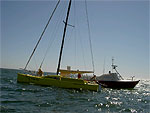 The second concern was getting assistance. Our radio was in the hull which
was lesson number two. The R33 tramp has a forward pocket designed so that
you can put an IPERB, GPS, hand held radio, flares and first aid kit in a
waterproof pouch and access the pocket from the bottom of the trampoline in
the event of a capsize. Because we were racing we never took the time to put
the "safety kit" in the pocket so a radio was not accessible. Luckily it was
a Sunday and although we were 3-5 miles offshore there was plenty of
traffic. We flagged over a 22 foot Trophy fishing boat with two men onboard
within 10 minutes. Although their radio did not work they sped off to a
Ranger 33 sailboat with a radio that did. I requested they call for the
Lifeguard and NOT the coast guard or harbor patrol. Lifeguard boats are
usually the guys who deal with the small day sailing cats and have a good
knowledge of righting a catamaran from a turtled position.
The second concern was getting assistance. Our radio was in the hull which
was lesson number two. The R33 tramp has a forward pocket designed so that
you can put an IPERB, GPS, hand held radio, flares and first aid kit in a
waterproof pouch and access the pocket from the bottom of the trampoline in
the event of a capsize. Because we were racing we never took the time to put
the "safety kit" in the pocket so a radio was not accessible. Luckily it was
a Sunday and although we were 3-5 miles offshore there was plenty of
traffic. We flagged over a 22 foot Trophy fishing boat with two men onboard
within 10 minutes. Although their radio did not work they sped off to a
Ranger 33 sailboat with a radio that did. I requested they call for the
Lifeguard and NOT the coast guard or harbor patrol. Lifeguard boats are
usually the guys who deal with the small day sailing cats and have a good
knowledge of righting a catamaran from a turtled position.
Within 5 to 10 minutes we had two lifeguard boats offering assistance. Their
first responsibility was getting the crew off the boat. Lifeguard boat no 4
picked up Pau, Acensi and the girls. I requested to stay onboard the R33 to
help with the righting. Before we proceeded we came up with two ways to
right the boat.one was to use the jib halyard and pull the mast tip to the
surface with one boat and then right the boat with the other. The simplest
suggestion came from the skipper of lifeguard boat #2 which was to just tie
lines to one hull and slowly pull the boat upright. The skipper had almost
20 years of experience righting small cats. Because of his experience we all
agreed to try the simplest solution first and if it failed to go to plan "B"
. My only concern was the stiff carbon mast and if it would resist breaking
under such heavy load. So I requested the lifeguard skipper, who was going
to pull the boat over, that he take his time and go slower than he might
with a small cat.
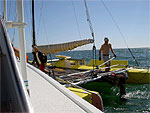 So plan "A" was simple to set up. Myself and a lifeguard simply took two
long ¾ inch lines and tied one line around the bow tube and the other line
around the rear tube. Each line was then lead under the deck and up and over
the inverted hulls. We tied them together making a bridle and led the line
to Lifeguard boat #2 which was downwind from the R33. Also due to the
trampolines design I could easily reach the mainsheet and jib sheet and
released them so if the boat came up easily the sails would not be sheeted
in.
So plan "A" was simple to set up. Myself and a lifeguard simply took two
long ¾ inch lines and tied one line around the bow tube and the other line
around the rear tube. Each line was then lead under the deck and up and over
the inverted hulls. We tied them together making a bridle and led the line
to Lifeguard boat #2 which was downwind from the R33. Also due to the
trampolines design I could easily reach the mainsheet and jib sheet and
released them so if the boat came up easily the sails would not be sheeted
in.
Once everything was tied up myself and the lifeguard were picked up by the
other lifeguard boat. All we could do now was wait and watch. Lifeguard boat
#2 proceeded to put power to the engines. But in this first attempt one
bridle line was longer than the other and loaded up and broke. So we
replaced the line with a stronger shorter line and started again. This time
the results were different.
Within 60 seconds of slowly powering the lifeguard boat up the mast cleared
the water and with a very gentle roll the boat came up and over landing
gently right side up. What a sight!!! The sails were sheeted out fully with
no broken battens or ripped sails. One hull was about one third full of
water but with the flotation bags and compartments we build into the R33 I
was not concerned about one hull sinking. The other hull was only filled
about 25 percent. The boat was not lurching or trying to speed away even in
the 15 to 18 knots of wind. The boat was into the wind and was a stable
platform with no signs of tipping over or sailing away.
So I then requested that I go back on the boat with one lifeguard to help
pump out water and to lower the sails. So we got onto the boat and I
proceeded to take down the main and jib while the other lifeguard attended
to the pumping out the water in the hulls. Within 10 to 15 minutes the boat
was dry and the sails secured ready for her crew to board again.
With the boat and crew secure the lifeguards asked us where we wanted to be
towed. I think the lifeguards were surprised by our answer. Pau, Acensi and
I looked at each other and said "we can sail the boat back in". We did
request however the girls stay onboard the lifeguard boat and be taken to
meet us when we sail into Alamitos bay. We were only 30 minutes sailing time
away from the bay.
So we thanked the lifeguards very much and watched them speed away with the
girls to the harbor. Pau, Acensi and I proceeded to raise the sails and
clean the deck up. By the time we got into the harbor the boat was back to
normal with no damage done to her rig, sails, trampoline or other gear. The
only things we lost were the sail covers and one of the cockpit cushions.
The only temporary damage was to the outboard motor which was under water
for about one hour. However even the outboard started soon after we cleaned
the sparkplugs and blew out the water in the fuel line that was attached to
the gas tank and the engine. It started up and has been running great for
the last week with no problems!!! Johnson makes a pretty good engine!
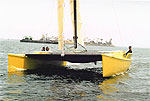 Everyone was in good spirits, especially Pau.he told me he was impressed
with the strength of the boat and how after an unplanned capsized we were
sailing again in little over an hour..amazing! Pau and his wife and friends
were amazing. They made this experience for me a good one as we learned so
very much about the boat. They were calm and cool through the whole event.
To show my appreciation I put three guys on the boat the next day and got
his R33 Turbo complete again with new sail covers and cockpit cushions. We
washed out the entire boat with fresh water and dry cleaned the cushions. By
the end of the day the boat looked like it just was launched and ready to go
sailing. Pau went sailing and cruising for the next week having a great time
on the boat. They sailed south to Dana Point the first day and spent the
night. They then sailed back up to Newport where they stayed two days
sailing, eating and having a great time. They then sailed back to Long Beach
and spent the night off the Queen Mary. They capped it off with only Pau and
Laura sailing to Catalina and spending two days. In fact, part due to the
experience, Pau is more confident in the boat more now than ever. He hopes
to get 5 more sailing in Barcelona where they can have a good fleet for
cruising and racing.
Everyone was in good spirits, especially Pau.he told me he was impressed
with the strength of the boat and how after an unplanned capsized we were
sailing again in little over an hour..amazing! Pau and his wife and friends
were amazing. They made this experience for me a good one as we learned so
very much about the boat. They were calm and cool through the whole event.
To show my appreciation I put three guys on the boat the next day and got
his R33 Turbo complete again with new sail covers and cockpit cushions. We
washed out the entire boat with fresh water and dry cleaned the cushions. By
the end of the day the boat looked like it just was launched and ready to go
sailing. Pau went sailing and cruising for the next week having a great time
on the boat. They sailed south to Dana Point the first day and spent the
night. They then sailed back up to Newport where they stayed two days
sailing, eating and having a great time. They then sailed back to Long Beach
and spent the night off the Queen Mary. They capped it off with only Pau and
Laura sailing to Catalina and spending two days. In fact, part due to the
experience, Pau is more confident in the boat more now than ever. He hopes
to get 5 more sailing in Barcelona where they can have a good fleet for
cruising and racing.
For myself, except for the frustration of capsizing my first multihull in my
30 years of sailing, I was very please with the results and lessons learned
about the experience! I would have never thought that we could be sailing in
an hour after an unplanned capsize 3-5 miles offshore. That same day with
everything still fresh in my mind I immediately started to write down how
and why the capsize happened in the first place, what could have prevented
the capsize, how, if capsized, what equipment would be needed to right the
boat and keep her crew safe and lastly but most importantly we learned a
proven technique in righting the boat in 3 foot wind waves, 4 foot swells
and in 15 knots of wind.
The R33 is now a much safer boat for the experience. In my next update we
will have an outline summarizing safety tips on how to prepare for a
capsize, prevent a capsize and how to right the boat in the event of a
capsize.
Hjem
| Reynolds 33 | Opplevelser
| Seilopplæring
| Sponsorturer | Regattadeltagelse
| Kontakt oss
|



